> ## Documentation Index
> Fetch the complete documentation index at: https://documentation.qonversion.io/llms.txt
> Use this file to discover all available pages before exploring further.
# User Properties
> Set custom user properties
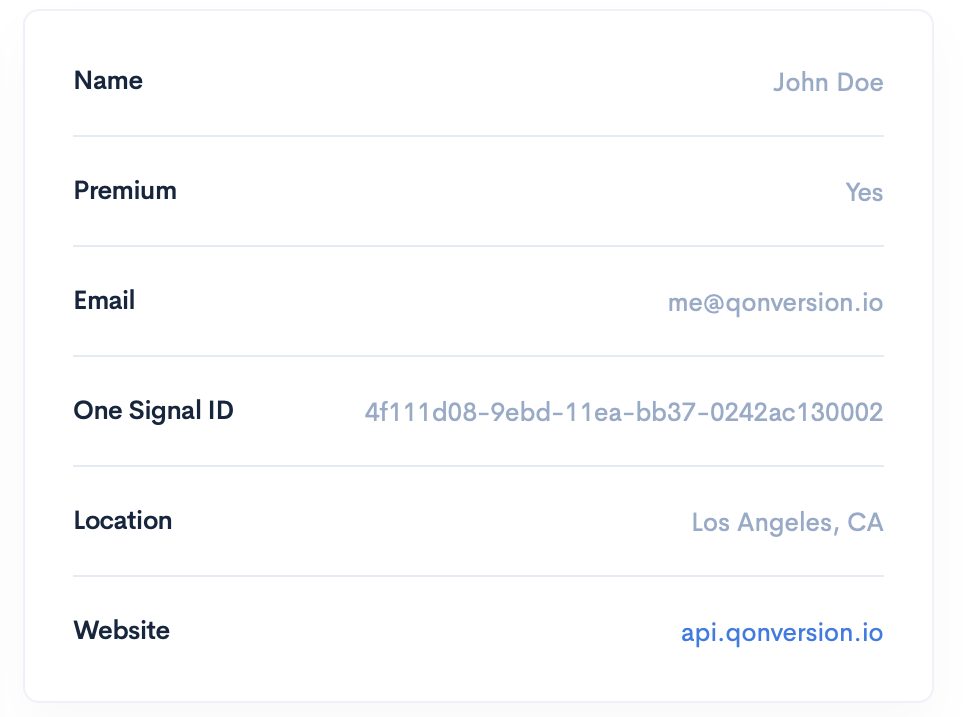
User properties are attributes you can set on a user level. You can send user properties to third-party platforms and use them in Qonversion for customer segmentation and analytics. Here is an example of user properties:
 ## Usage
There are two types of user properties: Qonversion-defined and custom user properties.
## Defined User Properties
We defined some common case properties and provided API for adding them:
```swift Swift theme={null}
Qonversion.shared().setUserProperty(.email, value: "me@qonversion.io")
```
```objectivec Objective-C theme={null}
[[Qonversion sharedInstance] setUserProperty:QONUserPropertyKeyEmail value:@"me@qonversion.io"];
```
```java Java theme={null}
Qonversion.getSharedInstance().setUserProperty(QUserPropertyKey.Email, "me@qonversion.io");
```
```kotlin Kotlin theme={null}
Qonversion.shared.setUserProperty(QUserPropertyKey.Email, "me@qonversion.io")
```
```dart Flutter theme={null}
Qonversion.getSharedInstance().setUserProperty(QUserPropertyKey.email, 'me@qonversion.io');
```
```typescript React Native theme={null}
Qonversion.getSharedInstance().setUserProperty(UserPropertyKey.EMAIL, 'me@qonversion.io');
```
```csharp Unity theme={null}
Qonversion.GetSharedInstance().SetUserProperty(UserPropertyKey.Email, "me@qonversion.io");
```
```typescript Cordova theme={null}
Qonversion.getSharedInstance().setUserProperty(Qonversion.UserPropertyKey.EMAIL, 'me@qonversion.io');
```
```typescript Capacitor theme={null}
Qonversion.getSharedInstance().setUserProperty(UserPropertyKey.EMAIL, 'me@qonversion.io');
```
The full list of the defined properties is provided below:
| Name | Key | Description |
| ----------------------- | -------------------------------- | -------------------------------------------------------------------------------------------------------------------------------------------------- |
| `Email` | `\_q_email` | User Email. It can be used for cross-platform authorization and integrations with Qonversion. |
| `Name` | `\_q_name` | User Name |
| `KochavaDeviceId` | `\_q_kochava_device_id` | Kochava Unique Device ID |
| `AppsFlyerUserId` | `\_q_appsflyer_user_id` | Customer user ID. It can be used to cross-reference your in-house data with AppsFlyer attribution data. |
| `AdjustAdId` | `\_q_adjust_adid` | Adjust Advertising ID |
| `CustomUserId` | `\_q_custom_user_id` | Your Internal User ID. Use User ID for third-party [Integrations ](integrations-overview)to attribute events to existing users in other platforms. |
| `FacebookAttribution` | `\_q_fb_attribution` | Mobile Cookie from the user's device |
| `FirebaseAppInstanceId` | `\_q_firebase_instance_id` | The identifier for a Firebase app |
| `AppSetId` | `\_q_app_set_id` | Unique user identifier for all the developer's applications on Android |
| `AdvertisingId` | `\_q_advertising_id` | Unique user identifier assigned to a mobile device on iOS |
| `PushWooshUserId` | `\_q_pushwoosh_user_id` | Unique user identifier assigned to Pushwoosh. Used for Pushwoosh integration. |
| `PushWooshHwId` | `\_q_pushwoosh_hwid` | Hardware identifier generated by Pushwoosh. Used for Pushwoosh integration. |
| `AppMetricaDeviceId` | `\_q_appmetrica_device_id` | Device identifier from AppMetrica. Used for AppMetrica integration. |
| `AppMetricalProfileId` | `\_q_appmetrica_user_profile_id` | User profile identifier from AppMetrica. Used for AppMetrica integration. |
## Custom User Properties
Additionally, you can add custom user property. Qonversion can send them to third-party integrations as well. For example, you can add user details and use that data to send personalized emails or push notifications via Mailchimp and OneSignal integrations.
```swift Swift theme={null}
Qonversion.shared().setCustomUserProperty("liked-app", value: "yes")
```
```objectivec Objective-C theme={null}
[[Qonversion sharedInstance] setCustomUserProperty: @"liked-app" value: @"yes"];
```
```java Java theme={null}
Qonversion.getSharedInstance().setCustomUserProperty("liked-app", "yes");
```
```kotlin Kotlin theme={null}
Qonversion.shared.setCustomUserProperty("liked-app", "yes")
```
```dart Flutter theme={null}
Qonversion.getSharedInstance().setCustomUserProperty('liked-app', 'yes');
```
```typescript React Native theme={null}
Qonversion.getSharedInstance().setCustomUserProperty('liked-app', 'yes');
```
```csharp Unity theme={null}
Qonversion.GetSharedInstance().SetCustomUserProperty("liked-app", "yes");
```
```typescript Cordova theme={null}
Qonversion.getSharedInstance().setCustomUserProperty('liked-app', 'yes');
```
```typescript Capacitor theme={null}
Qonversion.getSharedInstance().setCustomUserProperty('liked-app', 'yes');
```
You can use letters **A-Za-z**, numbers, and the following symbols **\_.:-** as a property key.
### Property setting order
To successfully set either Defined or Custom User Properties, launch Qonversion SDK first. [Learn more.](install-sdk)
## Get User Properties
You can get user properties set for a current user as follows:
```swift Swift theme={null}
Qonversion.shared().userProperties({ userProperties, error in
if let error = error {
// Handle error
return
}
userProperties?.properties.forEach({ userProperty in
print("User property: ", "key: ", userProperty.key, ", value: ", userProperty.value)
})
});
```
```objectivec Objective-C theme={null}
[[Qonversion sharedInstance] userProperties:^(QONUserProperties * _Nullable userProperties, NSError * _Nullable error) {
if (error) {
// Handle error
return;
}
[userProperties.properties enumerateObjectsUsingBlock:^(QONUserProperty * _Nonnull userProperty, NSUInteger idx, BOOL * _Nonnull stop) {
NSLog(@"User property: key: %@, value: %@", userProperty.key, userProperty.value);
}];
}];
```
```java Java theme={null}
Qonversion.getSharedInstance().userProperties(new QonversionUserPropertiesCallback() {
@Override
public void onSuccess(@NonNull QUserProperties userProperties) {
for (QUserProperty property : userProperties.getProperties()) {
Log.d("User property", "Key: " + property.getKey() +
", value: " + property.getValue());
}
}
@Override
public void onError(@NonNull QonversionError error) {
// handle error here
}
});
```
```kotlin Kotlin theme={null}
Qonversion.shared.userProperties(object : QonversionUserPropertiesCallback {
override fun onSuccess(userProperties: QUserProperties) {
userProperties.properties.forEach {
Log.d("User property", "key: ${it.key}, value: ${it.value}")
}
}
override fun onError(error: QonversionError) {
// handle error here
}
})
```
```dart Flutter theme={null}
try {
QUserProperties userProperties = await Qonversion.getSharedInstance().userProperties();
userProperties.properties.forEach((userProperty) {
print('User property - key: ' + userProperty.key + ', value: ' + userProperty.value);
});
} catch (e) {
// handle error here
}
```
```typescript React Native theme={null}
try {
const userProperties = await Qonversion.getSharedInstance().userProperties();
userProperties.properties.forEach(userProperty => {
console.log('User property - key:' + userProperty.key + ', value: ' + userProperty.value);
});
} catch (e) {
// handle error here
}
```
```csharp Unity theme={null}
Qonversion.GetSharedInstance().UserProperties((userProperties, error) =>
{
if (error != null)
{
// Handle the error
Debug.LogError("Error" + error);
}
else
{
userProperties.Properties.ForEach(userProperty => {
Debug.Log("User property - key: " + userProperty.Key + ", value: " + userProperty.Value);
});
}
});
```
```typescript Cordova theme={null}
try {
const userProperties = await Qonversion.getSharedInstance().userProperties();
userProperties.properties.forEach(userProperty => {
console.log('User property - key:' + userProperty.key + ', value: ' + userProperty.value);
});
} catch (e) {
// handle error here
}
```
```typescript Capacitor theme={null}
try {
const userProperties = await Qonversion.getSharedInstance().userProperties();
userProperties.properties.forEach(userProperty => {
console.log('User property - key:' + userProperty.key + ', value: ' + userProperty.value);
});
} catch (e) {
// handle error here
}
```
The object returned by `userProperties` method contains several utility fields and methods:
```swift Swift theme={null}
Qonversion.shared().userProperties({ userProperties, error in
...
// List of all user properties
let allProperties = userProperties?.properties
// Subset of all user properties, which were set using Qonversion-defined keys
let definedProperties = userProperties?.definedProperties
// Subset of all user properties, which were set using custom keys
let customProperties = userProperties?.customProperties
// A flattened version of all user properties as a key-value map
let flatPropertiesMap = userProperties?.flatPropertiesMap
// A flattened version of defined user properties as a key-value map
let flatDefinedPropertiesMap = userProperties?.flatDefinedPropertiesMap
// A flattened version of custom user properties as a key-value map
let flatCustomPropertiesMap = userProperties?.flatCustomPropertiesMap
// Searches for a property with the given property key in all properties list
let customProperty = userProperties?.property(for: "customKey")
// Searches for a property with the given Qonversion-defined property key in the defined properties list.
let emailProperty = userProperties?.definedProperty(for: .email)
});
```
```objectivec Objective-C theme={null}
[[Qonversion sharedInstance] userProperties:^(QONUserProperties * _Nullable userProperties, NSError * _Nullable error) {
...
// List of all user properties
NSMutableArray *allProperties = userProperties.properties;
// Subset of all user properties, which were set using Qonversion-defined keys
NSMutableArray *definedProperties = userProperties.definedProperties;
// Subset of all user properties, which were set using custom keys
NSMutableArray *customProperties = userProperties.customProperties;
// A flattened version of all user properties as a key-value map
NSMutableDictionary *flatPropertiesMap = userProperties.flatPropertiesMap;
// A flattened version of defined user properties as a key-value map
NSMutableDictionary *flatDefinedPropertiesMap = userProperties.flatDefinedPropertiesMap;
// A flattened version of custom user properties as a key-value map
NSMutableDictionary *flatCustomPropertiesMap = userProperties.flatCustomPropertiesMap;
// Searches for a property with the given property key in all properties list
QONUserProperty *customProperty = [userProperties propertyForKey:@"customKey"];
// Searches for a property with the given Qonversion-defined property key in the defined properties list.
QONUserProperty *emailProperty = [userProperties definedPropertyForKey:QONUserPropertyKeyEmail];
}];
```
```java Java theme={null}
Qonversion.getSharedInstance().userProperties(new QonversionUserPropertiesCallback() {
@Override
public void onSuccess(@NonNull QUserProperties userProperties) {
// List of all user properties
List allProperties = userProperties.getProperties();
// Subset of all user properties, which were set using Qonversion-defined keys
List definedProperties = userProperties.getDefinedProperties();
// Subset of all user properties, which were set using custom keys
List customProperties = userProperties.getCustomProperties();
// A flattened version of all user properties as a key-value map
Map flatPropertiesMap = userProperties.getFlatPropertiesMap();
// A flattened version of defined user properties as a key-value map
Map flatDefinedPropertiesMap = userProperties.getFlatDefinedPropertiesMap();
// A flattened version of custom user properties as a key-value map
Map flatCustomPropertiesMap = userProperties.getFlatCustomPropertiesMap();
// Searches for a property with the given property key in all properties list
QUserProperty customProperty = userProperties.getProperty("customKey");
// Searches for a property with the given Qonversion-defined property key in the defined properties list.
QUserProperty emailProperty = userProperties.getDefinedProperty(QUserPropertyKey.Email);
}
...
});
```
```kotlin Kotlin theme={null}
Qonversion.shared.userProperties(object : QonversionUserPropertiesCallback {
override fun onSuccess(userProperties: QUserProperties) {
// List of all user properties
val allProperties = userProperties.properties
// Subset of all user properties, which were set using Qonversion-defined keys
val definedProperties = userProperties.definedProperties
// Subset of all user properties, which were set using custom keys
val customProperties = userProperties.customProperties
// A flattened version of all user properties as a key-value map
val flatPropertiesMap = userProperties.flatPropertiesMap
// A flattened version of defined user properties as a key-value map
val flatDefinedPropertiesMap = userProperties.flatDefinedPropertiesMap
// A flattened version of custom user properties as a key-value map
val flatCustomPropertiesMap = userProperties.flatCustomPropertiesMap
// Searches for a property with the given property key in all properties list
val customProperty = userProperties.getProperty("customKey")
// Searches for a property with the given Qonversion-defined property key in the defined properties list.
val emailProperty = userProperties.getDefinedProperty(QUserPropertyKey.Email)
}
...
})
```
```dart Flutter theme={null}
var userProperties = await Qonversion.getSharedInstance().userProperties();
// List of all user properties
var allProperties = userProperties.properties;
// Subset of all user properties, which were set using Qonversion-defined keys
var definedProperties = userProperties.definedProperties;
// Subset of all user properties, which were set using custom keys
var customProperties = userProperties.customProperties;
// A flattened version of all user properties as a key-value map
var flatPropertiesMap = userProperties.flatPropertiesMap;
// A flattened version of defined user properties as a key-value map
var flatDefinedPropertiesMap = userProperties.flatDefinedPropertiesMap;
// A flattened version of custom user properties as a key-value map
var flatCustomPropertiesMap = userProperties.flatCustomPropertiesMap;
// Searches for a property with the given property key in all properties list
var customProperty = userProperties.getProperty("customKey");
// Searches for a property with the given Qonversion-defined property key in the defined properties list.
var emailProperty = userProperties.getDefinedProperty(QUserPropertyKey.email);
```
```typescript React Native theme={null}
const userProperties = await Qonversion.getSharedInstance().userProperties();
// List of all user properties
const allProperties = userProperties.properties;
// Subset of all user properties, which were set using Qonversion-defined keys
const definedProperties = userProperties.definedProperties;
// Subset of all user properties, which were set using custom keys
const customProperties = userProperties.customProperties;
// A flattened version of all user properties as a key-value map
const flatPropertiesMap = userProperties.flatPropertiesMap;
// A flattened version of defined user properties as a key-value map
const flatDefinedPropertiesMap = userProperties.flatDefinedPropertiesMap;
// A flattened version of custom user properties as a key-value map
const flatCustomPropertiesMap = userProperties.flatCustomPropertiesMap;
// Searches for a property with the given property key in all properties list
const customProperty = userProperties.getProperty('customKey');
// Searches for a property with the given Qonversion-defined property key in the defined properties list.
const emailProperty = userProperties.getDefinedProperty(UserPropertyKey.EMAIL);
```
```csharp Unity theme={null}
Qonversion.GetSharedInstance().UserProperties((userProperties, error) =>
{
...
// List of all user properties
List allProperties = userProperties.Properties;
// Subset of all user properties, which were set using Qonversion-defined keys
List definedProperties = userProperties.DefinedProperties;
// Subset of all user properties, which were set using custom keys
List customProperties = userProperties.CustomProperties;
// A flattened version of all user properties as a key-value map
Dictionary flatPropertiesMap = userProperties.FlatPropertiesMap;
// A flattened version of defined user properties as a key-value map
Dictionary flatDefinedPropertiesMap = userProperties.FlatDefinedPropertiesMap;
// A flattened version of custom user properties as a key-value map
Dictionary flatCustomPropertiesMap = userProperties.FlatCustomPropertiesMap;
// Searches for a property with the given property key in all properties list
UserProperty customProperty = userProperties.GetProperty("customKey");
// Searches for a property with the given Qonversion-defined property key in the defined properties list.
UserProperty emailProperty = userProperties.GetDefinedProperty(UserPropertyKey.Email);
});
```
```typescript Cordova theme={null}
const userProperties = await Qonversion.getSharedInstance().userProperties();
// List of all user properties
const allProperties = userProperties.properties;
// Subset of all user properties, which were set using Qonversion-defined keys
const definedProperties = userProperties.definedProperties;
// Subset of all user properties, which were set using custom keys
const customProperties = userProperties.customProperties;
// A flattened version of all user properties as a key-value map
const flatPropertiesMap = userProperties.flatPropertiesMap;
// A flattened version of defined user properties as a key-value map
const flatDefinedPropertiesMap = userProperties.flatDefinedPropertiesMap;
// A flattened version of custom user properties as a key-value map
const flatCustomPropertiesMap = userProperties.flatCustomPropertiesMap;
// Searches for a property with the given property key in all properties list
const customProperty = userProperties.getProperty('customKey');
// Searches for a property with the given Qonversion-defined property key in the defined properties list.
const emailProperty = userProperties.getDefinedProperty(Qonversion.UserPropertyKey.EMAIL);
```
```typescript Capacitor theme={null}
const userProperties = await Qonversion.getSharedInstance().userProperties();
// List of all user properties
const allProperties = userProperties.properties;
// Subset of all user properties, which were set using Qonversion-defined keys
const definedProperties = userProperties.definedProperties;
// Subset of all user properties, which were set using custom keys
const customProperties = userProperties.customProperties;
// A flattened version of all user properties as a key-value map
const flatPropertiesMap = userProperties.flatPropertiesMap;
// A flattened version of defined user properties as a key-value map
const flatDefinedPropertiesMap = userProperties.flatDefinedPropertiesMap;
// A flattened version of custom user properties as a key-value map
const flatCustomPropertiesMap = userProperties.flatCustomPropertiesMap;
// Searches for a property with the given property key in all properties list
const customProperty = userProperties.getProperty('customKey');
// Searches for a property with the given Qonversion-defined property key in the defined properties list.
const emailProperty = userProperties.getDefinedProperty(UserPropertyKey.EMAIL);
```
## (Optional) Set User ID
If you want to implement cross-platform (Android, IOS, and Web) user entitlement management, please, follow the [User Identity guide](user-identifiers#3-user-identity).
To match Qonversion revenue events to users in [third-party tools](integrations-overview), you need to set the identical user IDs in all of them:
```swift Swift theme={null}
Qonversion.shared().setUserProperty(.userID, value: "yourSideUserId")
```
```objectivec Objective-C theme={null}
[[Qonversion sharedInstance] setUserProperty:QNUserPropertyKeyUserID value:@"yourSideUserId"];
```
```java Java theme={null}
Qonversion.getSharedInstance().setUserProperty(QUserPropertyKey.CustomUserId, "yourSideUserID");
```
```kotlin Kotlin theme={null}
Qonversion.shared.setUserProperty(QUserPropertyKey.CustomUserId, "yourSideUserID")
```
```dart Flutter theme={null}
Qonversion.getSharedInstance().setUserProperty(QUserPropertyKey.customUserId, 'yourSideUserId');
```
```typescript React Native theme={null}
Qonversion.getSharedInstance().setUserProperty(UserPropertyKey.CUSTOM_USER_ID, 'yourSideUserId');
```
```csharp Unity theme={null}
Qonversion.GetSharedInstance().SetUserProperty(UserPropertyKey.CustomUserId, "yourSideUserId");
```
```typescript Cordova theme={null}
Qonversion.getSharedInstance().setUserProperty(Qonversion.UserPropertyKey.CUSTOM_USER_ID, 'yourSideUserId');
```
```typescript Capacitor theme={null}
Qonversion.getSharedInstance().setUserProperty(UserPropertyKey.CUSTOM_USER_ID, 'yourSideUserId');
```
The user ID improves the quality of events matching to the platforms where event attribution is not exclusively based on IDFA or GAID.
## (Optional) Set IDFA (Identifier for Advertisers, iOS 14.5+ only)
On iOS 14.5+, after requesting the app tracking permission using ATT, you need to notify Qonversion if tracking is allowed and IDFA is available. This will help to have precise attribution in Adjust, AppsFlyer, Singular and other [Qonversion integrations](integrations-overview).
```swift Swift theme={null}
ATTrackingManager.requestTrackingAuthorization { status in
switch status {
case .authorized:
Qonversion.shared().collectAdvertisingId()
// handle other states below
}
}
```
```objectivec Objective-C theme={null}
[ATTrackingManager requestTrackingAuthorizationWithCompletionHandler:^(ATTrackingManagerAuthorizationStatus status) {
switch (status) {
case ATTrackingManagerAuthorizationStatusAuthorized:
[[Qonversion sharedInstance] collectAdvertisingId];
break;
// handle other states if needed
default:
break;
}
}];
```
```dart Flutter theme={null}
Qonversion.getSharedInstance().collectAdvertisingId();
```
```typescript React Native theme={null}
Qonversion.getSharedInstance().collectAdvertisingId();
```
```csharp Unity theme={null}
Qonversion.GetSharedInstance().CollectAdvertisingId();
```
```typescript Cordova theme={null}
Qonversion.getSharedInstance().collectAdvertisingId();
```
```typescript Capacitor theme={null}
Qonversion.getSharedInstance().collectAdvertisingId();
```
## (Optional) Set ASID (App set ID, Android 12+ only)
On Android 12+, you can provide an App set ID to have it used in [Qonversion integrations](integrations-overview).
Add `com.google.android.gms:play-services-appset` as the dependency to your project and write the following code.
```java Java theme={null}
final AppSetIdClient client = AppSet.getClient(context);
final Task task = client.getAppSetIdInfo();
task.addOnSuccessListener(info -> {
final String id = info.getId();
Qonversion.getSharedInstance().setUserProperty(QUserPropertyKey.AppSetId, id);
});
```
```kotlin Kotlin theme={null}
val client = AppSet.getClient(requireContext())
client.appSetIdInfo.addOnSuccessListener { info: AppSetIdInfo ->
Qonversion.shared.setUserProperty(QUserPropertyKey.AppSetId, info.id)
}
```
```dart Flutter theme={null}
Qonversion.getSharedInstance().setUserProperty(QUserPropertyKey.appSetId, appSetId);
```
```typescript React Native theme={null}
Qonversion.getSharedInstance().setUserProperty(UserPropertyKey.APP_SET_ID, appSetId);
```
```csharp Unity theme={null}
Qonversion.GetSharedInstance().SetUserProperty(UserPropertyKey.AppSetId, appSetId);
```
```typescript Cordova theme={null}
Qonversion.getSharedInstance().setUserProperty(Qonversion.UserPropertyKey.APP_SET_ID, appSetId);
```
```typescript Capacitor theme={null}
Qonversion.getSharedInstance().setUserProperty(UserPropertyKey.APP_SET_ID, appSetId);
```
***
[Web SDK](web-sdk)
[Server Notifications](server-notifications)
## Usage
There are two types of user properties: Qonversion-defined and custom user properties.
## Defined User Properties
We defined some common case properties and provided API for adding them:
```swift Swift theme={null}
Qonversion.shared().setUserProperty(.email, value: "me@qonversion.io")
```
```objectivec Objective-C theme={null}
[[Qonversion sharedInstance] setUserProperty:QONUserPropertyKeyEmail value:@"me@qonversion.io"];
```
```java Java theme={null}
Qonversion.getSharedInstance().setUserProperty(QUserPropertyKey.Email, "me@qonversion.io");
```
```kotlin Kotlin theme={null}
Qonversion.shared.setUserProperty(QUserPropertyKey.Email, "me@qonversion.io")
```
```dart Flutter theme={null}
Qonversion.getSharedInstance().setUserProperty(QUserPropertyKey.email, 'me@qonversion.io');
```
```typescript React Native theme={null}
Qonversion.getSharedInstance().setUserProperty(UserPropertyKey.EMAIL, 'me@qonversion.io');
```
```csharp Unity theme={null}
Qonversion.GetSharedInstance().SetUserProperty(UserPropertyKey.Email, "me@qonversion.io");
```
```typescript Cordova theme={null}
Qonversion.getSharedInstance().setUserProperty(Qonversion.UserPropertyKey.EMAIL, 'me@qonversion.io');
```
```typescript Capacitor theme={null}
Qonversion.getSharedInstance().setUserProperty(UserPropertyKey.EMAIL, 'me@qonversion.io');
```
The full list of the defined properties is provided below:
| Name | Key | Description |
| ----------------------- | -------------------------------- | -------------------------------------------------------------------------------------------------------------------------------------------------- |
| `Email` | `\_q_email` | User Email. It can be used for cross-platform authorization and integrations with Qonversion. |
| `Name` | `\_q_name` | User Name |
| `KochavaDeviceId` | `\_q_kochava_device_id` | Kochava Unique Device ID |
| `AppsFlyerUserId` | `\_q_appsflyer_user_id` | Customer user ID. It can be used to cross-reference your in-house data with AppsFlyer attribution data. |
| `AdjustAdId` | `\_q_adjust_adid` | Adjust Advertising ID |
| `CustomUserId` | `\_q_custom_user_id` | Your Internal User ID. Use User ID for third-party [Integrations ](integrations-overview)to attribute events to existing users in other platforms. |
| `FacebookAttribution` | `\_q_fb_attribution` | Mobile Cookie from the user's device |
| `FirebaseAppInstanceId` | `\_q_firebase_instance_id` | The identifier for a Firebase app |
| `AppSetId` | `\_q_app_set_id` | Unique user identifier for all the developer's applications on Android |
| `AdvertisingId` | `\_q_advertising_id` | Unique user identifier assigned to a mobile device on iOS |
| `PushWooshUserId` | `\_q_pushwoosh_user_id` | Unique user identifier assigned to Pushwoosh. Used for Pushwoosh integration. |
| `PushWooshHwId` | `\_q_pushwoosh_hwid` | Hardware identifier generated by Pushwoosh. Used for Pushwoosh integration. |
| `AppMetricaDeviceId` | `\_q_appmetrica_device_id` | Device identifier from AppMetrica. Used for AppMetrica integration. |
| `AppMetricalProfileId` | `\_q_appmetrica_user_profile_id` | User profile identifier from AppMetrica. Used for AppMetrica integration. |
## Custom User Properties
Additionally, you can add custom user property. Qonversion can send them to third-party integrations as well. For example, you can add user details and use that data to send personalized emails or push notifications via Mailchimp and OneSignal integrations.
```swift Swift theme={null}
Qonversion.shared().setCustomUserProperty("liked-app", value: "yes")
```
```objectivec Objective-C theme={null}
[[Qonversion sharedInstance] setCustomUserProperty: @"liked-app" value: @"yes"];
```
```java Java theme={null}
Qonversion.getSharedInstance().setCustomUserProperty("liked-app", "yes");
```
```kotlin Kotlin theme={null}
Qonversion.shared.setCustomUserProperty("liked-app", "yes")
```
```dart Flutter theme={null}
Qonversion.getSharedInstance().setCustomUserProperty('liked-app', 'yes');
```
```typescript React Native theme={null}
Qonversion.getSharedInstance().setCustomUserProperty('liked-app', 'yes');
```
```csharp Unity theme={null}
Qonversion.GetSharedInstance().SetCustomUserProperty("liked-app", "yes");
```
```typescript Cordova theme={null}
Qonversion.getSharedInstance().setCustomUserProperty('liked-app', 'yes');
```
```typescript Capacitor theme={null}
Qonversion.getSharedInstance().setCustomUserProperty('liked-app', 'yes');
```
You can use letters **A-Za-z**, numbers, and the following symbols **\_.:-** as a property key.
### Property setting order
To successfully set either Defined or Custom User Properties, launch Qonversion SDK first. [Learn more.](install-sdk)
## Get User Properties
You can get user properties set for a current user as follows:
```swift Swift theme={null}
Qonversion.shared().userProperties({ userProperties, error in
if let error = error {
// Handle error
return
}
userProperties?.properties.forEach({ userProperty in
print("User property: ", "key: ", userProperty.key, ", value: ", userProperty.value)
})
});
```
```objectivec Objective-C theme={null}
[[Qonversion sharedInstance] userProperties:^(QONUserProperties * _Nullable userProperties, NSError * _Nullable error) {
if (error) {
// Handle error
return;
}
[userProperties.properties enumerateObjectsUsingBlock:^(QONUserProperty * _Nonnull userProperty, NSUInteger idx, BOOL * _Nonnull stop) {
NSLog(@"User property: key: %@, value: %@", userProperty.key, userProperty.value);
}];
}];
```
```java Java theme={null}
Qonversion.getSharedInstance().userProperties(new QonversionUserPropertiesCallback() {
@Override
public void onSuccess(@NonNull QUserProperties userProperties) {
for (QUserProperty property : userProperties.getProperties()) {
Log.d("User property", "Key: " + property.getKey() +
", value: " + property.getValue());
}
}
@Override
public void onError(@NonNull QonversionError error) {
// handle error here
}
});
```
```kotlin Kotlin theme={null}
Qonversion.shared.userProperties(object : QonversionUserPropertiesCallback {
override fun onSuccess(userProperties: QUserProperties) {
userProperties.properties.forEach {
Log.d("User property", "key: ${it.key}, value: ${it.value}")
}
}
override fun onError(error: QonversionError) {
// handle error here
}
})
```
```dart Flutter theme={null}
try {
QUserProperties userProperties = await Qonversion.getSharedInstance().userProperties();
userProperties.properties.forEach((userProperty) {
print('User property - key: ' + userProperty.key + ', value: ' + userProperty.value);
});
} catch (e) {
// handle error here
}
```
```typescript React Native theme={null}
try {
const userProperties = await Qonversion.getSharedInstance().userProperties();
userProperties.properties.forEach(userProperty => {
console.log('User property - key:' + userProperty.key + ', value: ' + userProperty.value);
});
} catch (e) {
// handle error here
}
```
```csharp Unity theme={null}
Qonversion.GetSharedInstance().UserProperties((userProperties, error) =>
{
if (error != null)
{
// Handle the error
Debug.LogError("Error" + error);
}
else
{
userProperties.Properties.ForEach(userProperty => {
Debug.Log("User property - key: " + userProperty.Key + ", value: " + userProperty.Value);
});
}
});
```
```typescript Cordova theme={null}
try {
const userProperties = await Qonversion.getSharedInstance().userProperties();
userProperties.properties.forEach(userProperty => {
console.log('User property - key:' + userProperty.key + ', value: ' + userProperty.value);
});
} catch (e) {
// handle error here
}
```
```typescript Capacitor theme={null}
try {
const userProperties = await Qonversion.getSharedInstance().userProperties();
userProperties.properties.forEach(userProperty => {
console.log('User property - key:' + userProperty.key + ', value: ' + userProperty.value);
});
} catch (e) {
// handle error here
}
```
The object returned by `userProperties` method contains several utility fields and methods:
```swift Swift theme={null}
Qonversion.shared().userProperties({ userProperties, error in
...
// List of all user properties
let allProperties = userProperties?.properties
// Subset of all user properties, which were set using Qonversion-defined keys
let definedProperties = userProperties?.definedProperties
// Subset of all user properties, which were set using custom keys
let customProperties = userProperties?.customProperties
// A flattened version of all user properties as a key-value map
let flatPropertiesMap = userProperties?.flatPropertiesMap
// A flattened version of defined user properties as a key-value map
let flatDefinedPropertiesMap = userProperties?.flatDefinedPropertiesMap
// A flattened version of custom user properties as a key-value map
let flatCustomPropertiesMap = userProperties?.flatCustomPropertiesMap
// Searches for a property with the given property key in all properties list
let customProperty = userProperties?.property(for: "customKey")
// Searches for a property with the given Qonversion-defined property key in the defined properties list.
let emailProperty = userProperties?.definedProperty(for: .email)
});
```
```objectivec Objective-C theme={null}
[[Qonversion sharedInstance] userProperties:^(QONUserProperties * _Nullable userProperties, NSError * _Nullable error) {
...
// List of all user properties
NSMutableArray *allProperties = userProperties.properties;
// Subset of all user properties, which were set using Qonversion-defined keys
NSMutableArray *definedProperties = userProperties.definedProperties;
// Subset of all user properties, which were set using custom keys
NSMutableArray *customProperties = userProperties.customProperties;
// A flattened version of all user properties as a key-value map
NSMutableDictionary *flatPropertiesMap = userProperties.flatPropertiesMap;
// A flattened version of defined user properties as a key-value map
NSMutableDictionary *flatDefinedPropertiesMap = userProperties.flatDefinedPropertiesMap;
// A flattened version of custom user properties as a key-value map
NSMutableDictionary *flatCustomPropertiesMap = userProperties.flatCustomPropertiesMap;
// Searches for a property with the given property key in all properties list
QONUserProperty *customProperty = [userProperties propertyForKey:@"customKey"];
// Searches for a property with the given Qonversion-defined property key in the defined properties list.
QONUserProperty *emailProperty = [userProperties definedPropertyForKey:QONUserPropertyKeyEmail];
}];
```
```java Java theme={null}
Qonversion.getSharedInstance().userProperties(new QonversionUserPropertiesCallback() {
@Override
public void onSuccess(@NonNull QUserProperties userProperties) {
// List of all user properties
List allProperties = userProperties.getProperties();
// Subset of all user properties, which were set using Qonversion-defined keys
List definedProperties = userProperties.getDefinedProperties();
// Subset of all user properties, which were set using custom keys
List customProperties = userProperties.getCustomProperties();
// A flattened version of all user properties as a key-value map
Map flatPropertiesMap = userProperties.getFlatPropertiesMap();
// A flattened version of defined user properties as a key-value map
Map flatDefinedPropertiesMap = userProperties.getFlatDefinedPropertiesMap();
// A flattened version of custom user properties as a key-value map
Map flatCustomPropertiesMap = userProperties.getFlatCustomPropertiesMap();
// Searches for a property with the given property key in all properties list
QUserProperty customProperty = userProperties.getProperty("customKey");
// Searches for a property with the given Qonversion-defined property key in the defined properties list.
QUserProperty emailProperty = userProperties.getDefinedProperty(QUserPropertyKey.Email);
}
...
});
```
```kotlin Kotlin theme={null}
Qonversion.shared.userProperties(object : QonversionUserPropertiesCallback {
override fun onSuccess(userProperties: QUserProperties) {
// List of all user properties
val allProperties = userProperties.properties
// Subset of all user properties, which were set using Qonversion-defined keys
val definedProperties = userProperties.definedProperties
// Subset of all user properties, which were set using custom keys
val customProperties = userProperties.customProperties
// A flattened version of all user properties as a key-value map
val flatPropertiesMap = userProperties.flatPropertiesMap
// A flattened version of defined user properties as a key-value map
val flatDefinedPropertiesMap = userProperties.flatDefinedPropertiesMap
// A flattened version of custom user properties as a key-value map
val flatCustomPropertiesMap = userProperties.flatCustomPropertiesMap
// Searches for a property with the given property key in all properties list
val customProperty = userProperties.getProperty("customKey")
// Searches for a property with the given Qonversion-defined property key in the defined properties list.
val emailProperty = userProperties.getDefinedProperty(QUserPropertyKey.Email)
}
...
})
```
```dart Flutter theme={null}
var userProperties = await Qonversion.getSharedInstance().userProperties();
// List of all user properties
var allProperties = userProperties.properties;
// Subset of all user properties, which were set using Qonversion-defined keys
var definedProperties = userProperties.definedProperties;
// Subset of all user properties, which were set using custom keys
var customProperties = userProperties.customProperties;
// A flattened version of all user properties as a key-value map
var flatPropertiesMap = userProperties.flatPropertiesMap;
// A flattened version of defined user properties as a key-value map
var flatDefinedPropertiesMap = userProperties.flatDefinedPropertiesMap;
// A flattened version of custom user properties as a key-value map
var flatCustomPropertiesMap = userProperties.flatCustomPropertiesMap;
// Searches for a property with the given property key in all properties list
var customProperty = userProperties.getProperty("customKey");
// Searches for a property with the given Qonversion-defined property key in the defined properties list.
var emailProperty = userProperties.getDefinedProperty(QUserPropertyKey.email);
```
```typescript React Native theme={null}
const userProperties = await Qonversion.getSharedInstance().userProperties();
// List of all user properties
const allProperties = userProperties.properties;
// Subset of all user properties, which were set using Qonversion-defined keys
const definedProperties = userProperties.definedProperties;
// Subset of all user properties, which were set using custom keys
const customProperties = userProperties.customProperties;
// A flattened version of all user properties as a key-value map
const flatPropertiesMap = userProperties.flatPropertiesMap;
// A flattened version of defined user properties as a key-value map
const flatDefinedPropertiesMap = userProperties.flatDefinedPropertiesMap;
// A flattened version of custom user properties as a key-value map
const flatCustomPropertiesMap = userProperties.flatCustomPropertiesMap;
// Searches for a property with the given property key in all properties list
const customProperty = userProperties.getProperty('customKey');
// Searches for a property with the given Qonversion-defined property key in the defined properties list.
const emailProperty = userProperties.getDefinedProperty(UserPropertyKey.EMAIL);
```
```csharp Unity theme={null}
Qonversion.GetSharedInstance().UserProperties((userProperties, error) =>
{
...
// List of all user properties
List allProperties = userProperties.Properties;
// Subset of all user properties, which were set using Qonversion-defined keys
List definedProperties = userProperties.DefinedProperties;
// Subset of all user properties, which were set using custom keys
List customProperties = userProperties.CustomProperties;
// A flattened version of all user properties as a key-value map
Dictionary flatPropertiesMap = userProperties.FlatPropertiesMap;
// A flattened version of defined user properties as a key-value map
Dictionary flatDefinedPropertiesMap = userProperties.FlatDefinedPropertiesMap;
// A flattened version of custom user properties as a key-value map
Dictionary flatCustomPropertiesMap = userProperties.FlatCustomPropertiesMap;
// Searches for a property with the given property key in all properties list
UserProperty customProperty = userProperties.GetProperty("customKey");
// Searches for a property with the given Qonversion-defined property key in the defined properties list.
UserProperty emailProperty = userProperties.GetDefinedProperty(UserPropertyKey.Email);
});
```
```typescript Cordova theme={null}
const userProperties = await Qonversion.getSharedInstance().userProperties();
// List of all user properties
const allProperties = userProperties.properties;
// Subset of all user properties, which were set using Qonversion-defined keys
const definedProperties = userProperties.definedProperties;
// Subset of all user properties, which were set using custom keys
const customProperties = userProperties.customProperties;
// A flattened version of all user properties as a key-value map
const flatPropertiesMap = userProperties.flatPropertiesMap;
// A flattened version of defined user properties as a key-value map
const flatDefinedPropertiesMap = userProperties.flatDefinedPropertiesMap;
// A flattened version of custom user properties as a key-value map
const flatCustomPropertiesMap = userProperties.flatCustomPropertiesMap;
// Searches for a property with the given property key in all properties list
const customProperty = userProperties.getProperty('customKey');
// Searches for a property with the given Qonversion-defined property key in the defined properties list.
const emailProperty = userProperties.getDefinedProperty(Qonversion.UserPropertyKey.EMAIL);
```
```typescript Capacitor theme={null}
const userProperties = await Qonversion.getSharedInstance().userProperties();
// List of all user properties
const allProperties = userProperties.properties;
// Subset of all user properties, which were set using Qonversion-defined keys
const definedProperties = userProperties.definedProperties;
// Subset of all user properties, which were set using custom keys
const customProperties = userProperties.customProperties;
// A flattened version of all user properties as a key-value map
const flatPropertiesMap = userProperties.flatPropertiesMap;
// A flattened version of defined user properties as a key-value map
const flatDefinedPropertiesMap = userProperties.flatDefinedPropertiesMap;
// A flattened version of custom user properties as a key-value map
const flatCustomPropertiesMap = userProperties.flatCustomPropertiesMap;
// Searches for a property with the given property key in all properties list
const customProperty = userProperties.getProperty('customKey');
// Searches for a property with the given Qonversion-defined property key in the defined properties list.
const emailProperty = userProperties.getDefinedProperty(UserPropertyKey.EMAIL);
```
## (Optional) Set User ID
If you want to implement cross-platform (Android, IOS, and Web) user entitlement management, please, follow the [User Identity guide](user-identifiers#3-user-identity).
To match Qonversion revenue events to users in [third-party tools](integrations-overview), you need to set the identical user IDs in all of them:
```swift Swift theme={null}
Qonversion.shared().setUserProperty(.userID, value: "yourSideUserId")
```
```objectivec Objective-C theme={null}
[[Qonversion sharedInstance] setUserProperty:QNUserPropertyKeyUserID value:@"yourSideUserId"];
```
```java Java theme={null}
Qonversion.getSharedInstance().setUserProperty(QUserPropertyKey.CustomUserId, "yourSideUserID");
```
```kotlin Kotlin theme={null}
Qonversion.shared.setUserProperty(QUserPropertyKey.CustomUserId, "yourSideUserID")
```
```dart Flutter theme={null}
Qonversion.getSharedInstance().setUserProperty(QUserPropertyKey.customUserId, 'yourSideUserId');
```
```typescript React Native theme={null}
Qonversion.getSharedInstance().setUserProperty(UserPropertyKey.CUSTOM_USER_ID, 'yourSideUserId');
```
```csharp Unity theme={null}
Qonversion.GetSharedInstance().SetUserProperty(UserPropertyKey.CustomUserId, "yourSideUserId");
```
```typescript Cordova theme={null}
Qonversion.getSharedInstance().setUserProperty(Qonversion.UserPropertyKey.CUSTOM_USER_ID, 'yourSideUserId');
```
```typescript Capacitor theme={null}
Qonversion.getSharedInstance().setUserProperty(UserPropertyKey.CUSTOM_USER_ID, 'yourSideUserId');
```
The user ID improves the quality of events matching to the platforms where event attribution is not exclusively based on IDFA or GAID.
## (Optional) Set IDFA (Identifier for Advertisers, iOS 14.5+ only)
On iOS 14.5+, after requesting the app tracking permission using ATT, you need to notify Qonversion if tracking is allowed and IDFA is available. This will help to have precise attribution in Adjust, AppsFlyer, Singular and other [Qonversion integrations](integrations-overview).
```swift Swift theme={null}
ATTrackingManager.requestTrackingAuthorization { status in
switch status {
case .authorized:
Qonversion.shared().collectAdvertisingId()
// handle other states below
}
}
```
```objectivec Objective-C theme={null}
[ATTrackingManager requestTrackingAuthorizationWithCompletionHandler:^(ATTrackingManagerAuthorizationStatus status) {
switch (status) {
case ATTrackingManagerAuthorizationStatusAuthorized:
[[Qonversion sharedInstance] collectAdvertisingId];
break;
// handle other states if needed
default:
break;
}
}];
```
```dart Flutter theme={null}
Qonversion.getSharedInstance().collectAdvertisingId();
```
```typescript React Native theme={null}
Qonversion.getSharedInstance().collectAdvertisingId();
```
```csharp Unity theme={null}
Qonversion.GetSharedInstance().CollectAdvertisingId();
```
```typescript Cordova theme={null}
Qonversion.getSharedInstance().collectAdvertisingId();
```
```typescript Capacitor theme={null}
Qonversion.getSharedInstance().collectAdvertisingId();
```
## (Optional) Set ASID (App set ID, Android 12+ only)
On Android 12+, you can provide an App set ID to have it used in [Qonversion integrations](integrations-overview).
Add `com.google.android.gms:play-services-appset` as the dependency to your project and write the following code.
```java Java theme={null}
final AppSetIdClient client = AppSet.getClient(context);
final Task task = client.getAppSetIdInfo();
task.addOnSuccessListener(info -> {
final String id = info.getId();
Qonversion.getSharedInstance().setUserProperty(QUserPropertyKey.AppSetId, id);
});
```
```kotlin Kotlin theme={null}
val client = AppSet.getClient(requireContext())
client.appSetIdInfo.addOnSuccessListener { info: AppSetIdInfo ->
Qonversion.shared.setUserProperty(QUserPropertyKey.AppSetId, info.id)
}
```
```dart Flutter theme={null}
Qonversion.getSharedInstance().setUserProperty(QUserPropertyKey.appSetId, appSetId);
```
```typescript React Native theme={null}
Qonversion.getSharedInstance().setUserProperty(UserPropertyKey.APP_SET_ID, appSetId);
```
```csharp Unity theme={null}
Qonversion.GetSharedInstance().SetUserProperty(UserPropertyKey.AppSetId, appSetId);
```
```typescript Cordova theme={null}
Qonversion.getSharedInstance().setUserProperty(Qonversion.UserPropertyKey.APP_SET_ID, appSetId);
```
```typescript Capacitor theme={null}
Qonversion.getSharedInstance().setUserProperty(UserPropertyKey.APP_SET_ID, appSetId);
```
***
[Web SDK](web-sdk)
[Server Notifications](server-notifications)